
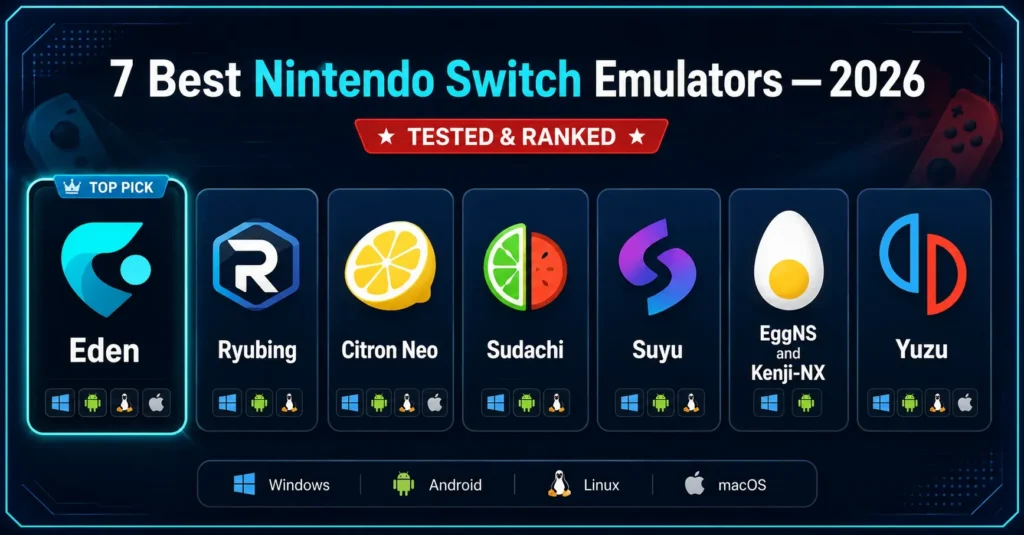
Your favorite Switch game drops to five frames per second, the audio crackles, and the app crashes right before a boss fight. Running games on a PC or phone sounds easy, but poor software can make it painful.
Choosing the best Switch emulator means looking at performance, loading speed, and setup ease. We tested the top tools using those criteria so you can start gaming without the headache.
Key Takeaways | Details |
Top Pick | The eden switch emulator delivers fast speed, clean updates, and great game support. |
Legal Safety | Emulators are legal software. Always extract your own keys and game files from your physical console. |
Disclaimer | We love gaming culture and respect Nintendo IP rights. We do not support pirated games. |
Emulators are legal to create and download. They act as basic hardware software. But the legal trouble starts when you run pirated game files.
Are Nintendo Switch Emulators Legal?
Downloading emulator code is 100% legal under U.S. copyright law. Emulators simply reverse-engineer console hardware. They do not contain proprietary Nintendo code.
However, playing games on them often breaks the law. Downloading game ROMs or decryption keys from the internet violates the Digital Millennium Copyright Act (DMCA). To stay legal, you must dump your own legally purchased games and console keys.
The Tropic Haze Lawsuit
Nintendo actively fights emulator projects that enable piracy. On February 26, 2024, Nintendo sued Tropic Haze LLC, the team behind the Yuzu emulator, in federal court. Nintendo claimed Yuzu bypassed encryption systems to play pirated games before release.
On March 4, 2024, Tropic Haze settled the lawsuit. They paid Nintendo $2.4 million in damages and permanently shut down Yuzu. This case showed that building an emulator is legal, but facilitating game piracy can still lead to swift legal consequences.
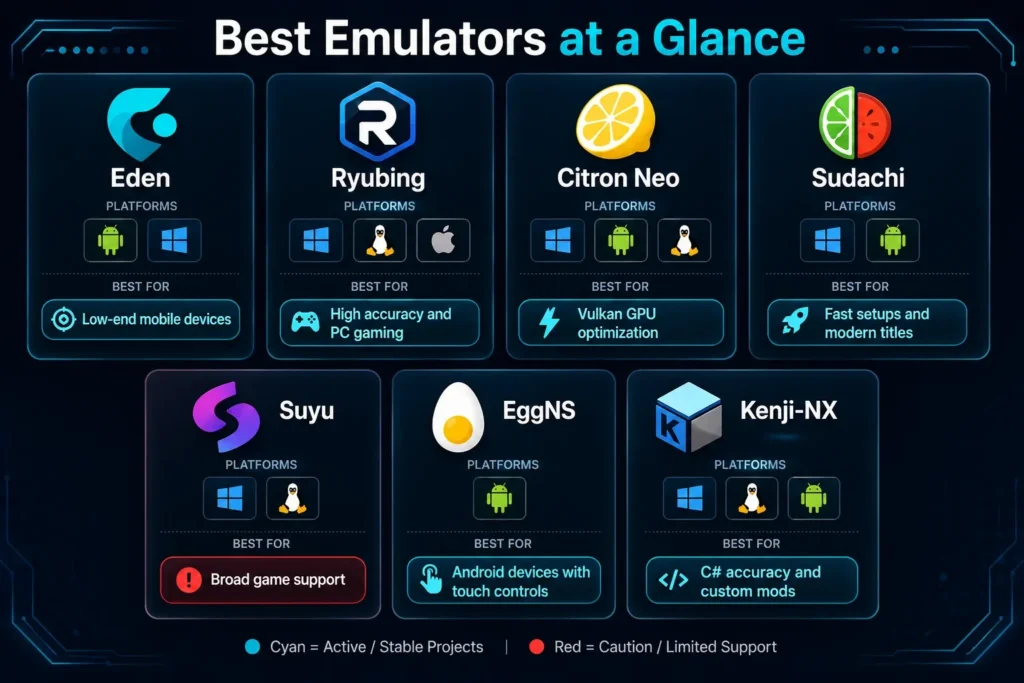
Best Emulators at a Glance
Emulator | Primary Platform | Still Works in 2026? | Best For |
Eden | Android, Windows | Yes (Active community forks) | Low-end mobile devices |
Ryubing | Windows, Linux, macOS | Yes (Active project) | High accuracy and PC gaming |
Citron Neo | Windows, Android, Linux | Yes (Nightly updates) | Vulkan GPU optimization |
Sudachi | Windows, Android | Yes (Archive builds work) | Fast setups and modern titles |
Suyu | Windows, Linux | Yes (Offline builds work) | Broad game support |
EggNS | Android | Yes (Active updates) | Android devices with touch controls |
Kenji-NX | Windows, Linux, Android | Yes (Active development) | C# accuracy and custom mods |
1. Eden, Best Overall
If you want the best Switch emulator for Android, Eden is a strong option to try first. It is an open-source Nintendo Switch emulator derived from Yuzu and Sudachi. The project maintains Android, Windows, Linux, and other builds.
Eden stands out because its Android version is actively developed. Recent releases added better Qualcomm driver support, Android 7 support, improved controls, per-game configuration, and other usability updates. Android devices still need Vulkan 1.1 support and enough processing power to run games well.
Why Eden is a strong Android choice
The biggest advantage is hardware compatibility. Eden’s documentation says Qualcomm Snapdragon devices generally receive the best support. Adreno 6xx and 7xx GPUs can also benefit from Turnip drivers. Stock Qualcomm drivers may offer better performance, while Turnip can provide better compatibility in some games.
Vulkan is also important for Android users. Eden supports Vulkan-based rendering, and recent development has focused on improving Vulkan behavior and Android performance. Developers have also added support for Turnip-related environment settings. These options can help users troubleshoot specific Adreno devices.
Android Builds
The project also offers three Android builds. Most users should choose the Standard APK. Flagship devices can use the Genshin Spoof build when specific optimizations help. Older devices, including Snapdragon 865-class hardware, can use the Legacy APK.
Need help getting started? Follow our full Android setup walkthrough.
Steam Deck Support
Eden also works beyond phones. The project provides a Steam Deck setup path through Desktop Mode. Users can install the Stable or Nightly AppImage and configure their legally dumped games, firmware, and keys.
Stable and Nightly Builds
Another reason to consider the Eden Switch emulator is its active release cycle. The project separates Stable and Nightly builds. Stable releases receive more testing, while Nightly builds provide newer fixes and experimental features.
For Android users, device choice still matters. A powerful Snapdragon processor with an Adreno GPU is generally the safer combination. A working Vulkan driver is essential. Performance can also vary by game, driver, and device configuration. Eden’s own architecture guide warns that Mali, PowerVR, and Xclipse GPUs can have weaker compatibility.
Overall, the Eden Switch emulator offers a strong mix of active development, Android support, Vulkan rendering, driver flexibility, and cross-platform support. It is a practical first choice for users with compatible Android hardware.
2. Ryubing, Best for Stability and established compatibility testing
Ryubing continues the Ryujinx codebase. It serves users who want an actively maintained fork after Ryujinx was discontinued.
Ryujinx was discontinued on October 1, 2024. The Ryubing team describes its project as a quality-of-life uplift for existing Ryujinx users.
Why Ryubing Offers Better Stability
Ryubing differs from an abandoned Ryujinx build. The project still provides Stable and Canary builds, which helps maintain its focus on stability.
Stable releases focus on a more reliable user experience. The project releases them about once a month.
Ryubing’s Move Beyond GitHub
Ryubing also faced a DMCA takedown and moved away from GitHub to its own self-hosted Git repository, following a pattern also seen with Eden.
This connection shows how several projects in the Switch emulator niche are reducing their reliance on a single public code-hosting platform.
Compatibility Testing
Ryubing maintains a dedicated compatibility tracker. The tracker requires testing with official Stable or Canary builds. It also keeps hacks, mods, and cheats disabled during compatibility testing. This gives users a clearer way to judge game support.
The original Ryujinx project had tested about 4,300 titles by May 2024. More than 4,100 titles booted past menus into gameplay. Around 3,550 titles were considered playable at that time.
Ryubing continues this compatibility-focused approach. Its tracker still receives game reports and updates in 2026. Recent entries include playable and in-game reports for several Switch titles.
Key Features
For users searching for the best Switch emulator for PC, Ryubing offers several mature features that fit that goal.
It supports:
- Vulkan
- OpenGL 4.5
- Metal through MoltenVK
- Resolution scaling
- FSR scaling filters
- Anti-aliasing
- Shader caching
Controller and DLC Support
Ryubing supports keyboards, mice, touch controls, Joy-Cons, and most controllers. Motion controls also work natively in most cases. Ryubing supports DLC management through its graphical interface.
Ryubing and GreemDev
GreemDev is closely connected to the project. It maintains the project’s server infrastructure. The official Ryubing organization also maintains tools for compatibility tracking and updates.
Final Verdict
Ryubing makes the strongest case for users who already liked Ryujinx. It preserves the established emulator base while continuing development, releases, documentation, and compatibility testing.
3. Citron NEO
Citron NEO is a newer project that followed the original Citron emulator after Nintendo targeted several Switch emulator repositories through DMCA notices in February 2026. GitHub was one of the platforms affected by that enforcement wave.
Citron NEO later emerged as a community project that picked up development where Citron left off. Its own documentation makes an important distinction. Citron NEO is not the same project as the former Citron site or a corporate successor to Yuzu. Its GitHub organization hosts the emulator source and builds repositories.
Why Citron NEO Stands Out
The biggest advantage is its continued development after the February 2026 disruption. Citron NEO published its first stable build on March 20, 2026. The release included CPU performance work, faster shader compilation, GPU improvements, and other emulator changes.
Development continued through mid- and late 2026. GitHub shows active emulator issues, pull requests, and CI builds. The project also provides Windows, Linux, macOS, and Android builds through its GitHub repositories.
The February 2026 events also confused the two projects. Some older guides still combine details from the original emulator with NEO. Nintendo’s enforcement action affected the earlier project during this period, and NEO later continued development as a separate community effort.
4. Sudachi
Sudachi is a Nintendo Switch emulator based on the Yuzu codebase. It supports Android, Windows, Linux, and macOS. The project uses the GPL-3.0 license for its source code and emerged as a notable Yuzu fork after development of the original project ended in 2024. The software later received compatibility and system-related improvements.
Development eventually stopped in 2025. Developer Jarrod Norwell shifted his focus toward Folium, and the final release was published on July 2, 2025. This makes the project different from actively maintained alternatives. Existing builds can still run compatible games, but users should not expect regular fixes or new features.
Setup also needs some manual work. Users must provide their own legally obtained Switch files. They also need to configure required keys and select their game directory. Android users may need extra graphics-driver settings, and results can vary by device, game, driver, and configuration.
For users who already have a compatible build, it remains worth considering. Its existing features and setup options can still be useful, but its discontinued development is an important limitation for new users.
5. Suyu, Use With Caution
Suyu emerged in March 2024 as a fork of the Yuzu Nintendo Switch emulator after Yuzu shut down. Its developers wanted to keep Switch emulation going. The project was written in C++ and targeted Windows, Linux, and Android builds.
Suyu and Piracy
Suyu also tried to distance itself from piracy. Its project documentation says users must provide their own legally obtained games and keys. It also states that the project does not support piracy or seek profit.
Why Suyu Raises Legal Concerns
The main concern is Suyu’s legal history. GitHub records show Nintendo submitted DMCA notices against Suyu and other Yuzu-based projects. Nintendo argued these projects used technology to bypass Switch security measures.
Suyu also faced a separate takedown on GitLab in March 2024. The project then moved its development to a self-hosted Git service. Ars Technica reported that Suyu developers described the project as being in a legal gray area at the time.
Suyu Release History
Suyu released v0.0.3 in April 2024. That release included firmware 18.0.0 fixes and other emulator changes. Its repository also lists GPL-3.0 licensing.
Should You Use Suyu?
Because of its legal history and limited release history, Suyu deserves caution. Users should obtain games and system files legally.
6. EggNS and Kenji-NX: Different Approaches
EggNS is an Android-based Nintendo Switch emulator from NXTeam Studios. Its official guide says it supports Android devices with Snapdragon 855 or newer chips. It also recommends at least 6GB of RAM and Android 11.
The emulator supports touch controls and Bluetooth controllers. Its Google Play listing reports more than 2.7 million downloads. It also says the app does not provide games. It uses an account-based setup. Its official guide requires users to register before starting games. The app also has a VIP model and in-app purchases listed on Google Play.
However, EggNS is closed-source. That makes independent code review harder than with open projects. Users have given different opinions about how it handles access and permissions.
Kenji-NX is another option for Switch emulation. It is an open-source project based on the Ryujinx codebase. Written in C#, the emulator is distributed under the MIT License.
Its Android version has received several useful updates. These include better controller support, save management, mod support, and cheat management. It also received stability improvements for devices powered by the Snapdragon 8 Elite chipset.
Kenji-NX was also affected by Nintendo’s February 2026 DMCA action. The action targeted several Switch emulator repositories. Kenji-NX’s Android release repository was among them.
7. Yuzu, Historical
Yuzu was a Switch emulator from Tropic Haze, the team also known for Citra. It ran on Windows and Linux, with an Android version available too. The project had a strong following before 2024. Its development ended after Nintendo took legal action against Tropic Haze.
Nintendo filed the case on February 26, 2024, in the U.S. District Court for Rhode Island. The case focused on Yuzu’s use of Nintendo’s technical protection measures. Tropic Haze agreed to settle the case on March 4. The agreement included a $2.4 million payment to Nintendo. It also ended the company’s work on Yuzu.
By March 6, 2024, the court had formally closed the case. It permanently barred Tropic Haze from distributing, marketing, or hosting Yuzu. The order also required Tropic Haze to surrender the Yuzu-emu.org domain. The Yuzu team confirmed the shutdown at the time. It said the Yuzu and Citra projects were being discontinued. Their code repositories and other community services were also taken offline.
Is Yuzu still available officially?
No. The original team no longer develops or distributes it. Read our full Yuzu story to see how this shutdown played out, and check how it compares to Ryujinx if you’re deciding what to use instead. Old copies can still appear on archive sites and other third-party pages. Those copies should not be confused with an official Yuzu release. Yuzu belongs in a historical section rather than a list of currently maintained emulators, since its development officially stopped in 2024.
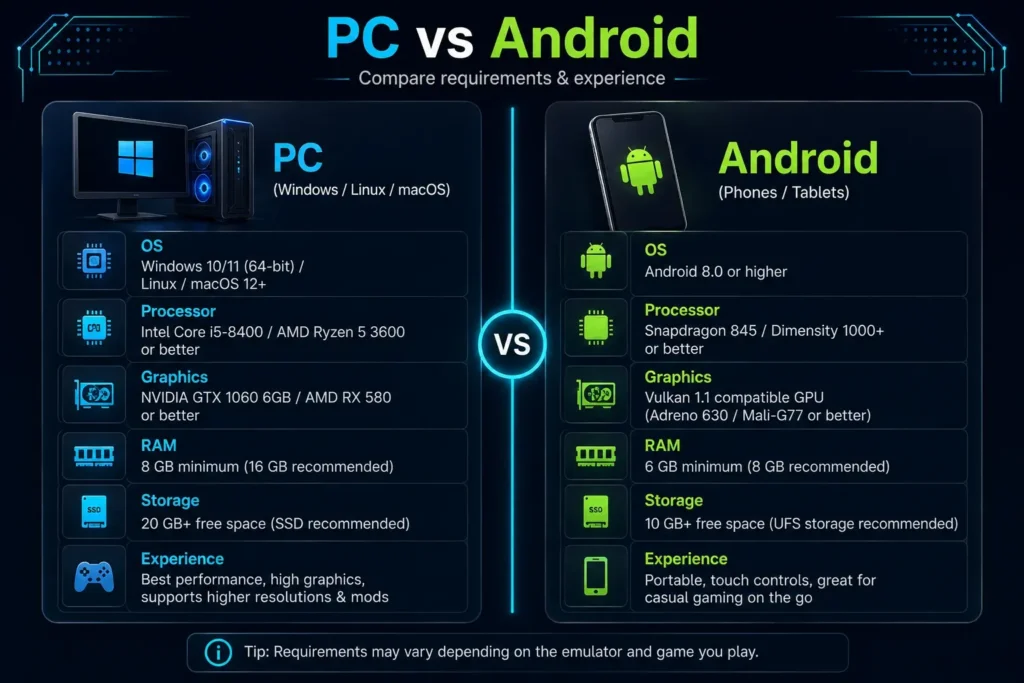
PC vs Android: Which Is Better
Feature / Factor | PC | Android |
Primary Focus | Maximum performance and graphical power | On-the-go gaming and portability |
Performance & Thermals | Steady frame rates with active cooling and dedicated GPUs | High initial speed, but thermal throttling reduces performance over time |
Emulation Capabilities | Uses the best switch emulator for pc (Eden/Ryubing) for 4K resolutions | Uses the best switch emulator for android (Citron) optimized for mobile chips |
Hardware & Processors | High-power x86 desktop and laptop processors | Mobile System-on-Chip (SoC) like Qualcomm Snapdragon |
Graphics Drivers | Native Vulkan and DirectX desktop drivers | Mobile Vulkan drivers (Turnip drivers work best on Snapdragon) |
Controls | Native support for keyboard, mouse, and USB controllers | Physical Bluetooth gamepads or touch controls |
Portability | Limited to desktop setups, laptops, or devices like Steam Deck | Highly portable using your everyday smartphone |
Verdict | Best for high frame rates, stability, and maximum visual quality | Best for convenience, travel, and quick casual gaming sessions |
Used Yuzu before? Here Is the Best Alternative Right Now
If you used Yuzu before, you know what happened in March 2024. Nintendo sued the Yuzu developers. They had to pay $2.4 million. Yuzu shut down its website and GitHub repository the same day.
A few months later, in October 2024, Ryujinx also stopped development. Nintendo contacted its lead developer directly. The lead developer agreed to stop working on the project. Now both Yuzu and Ryujinx are gone.
What to Use Now (Eden and Ryubing)
You now have two main options: Eden and Ryubing.
Eden is an open-source Nintendo Switch emulator. It is a fork of the Yuzu codebase. Eden is the most actively developed emulator right now. It works on Windows, Linux, macOS, and Android. Its latest stable version is v0.2.1, released on June 1, 2026.
Ryubing is a community fork of Ryujinx. It continues Ryujinx’s work with monthly stable releases and frequent canary builds. Ryubing suits players who want proven accuracy on PC, while Eden offers broader platform support.
Which Emulator Should You Choose?
Eden works best for cross-platform and Android users. Ryubing works best for PC users who want Ryujinx-level accuracy. Both remain actively developed in 2026.
Conclusion
Yuzu’s shutdown left a big gap in the Switch emulation scene. Eden and Ryubing have filled that gap together. If you used Yuzu before, pick based on your platform: Eden for cross-platform play, Ryubing for PC accuracy.
Common Emulator Problems
- Missing Keys and Firmware: Switch emulators require valid prod keys to decrypt game files. Matching firmware is also essential because outdated files cannot run newer updates or DLC.
- Driver Incompatibility: Stock graphics drivers cause frequent boot crashes. On Android, switch from the stock Vulkan driver to a compatible Turnip driver for better Adreno GPU stability.
- Corrupted Shader Caches: Old caches trigger black screens and severe stutter. Clear shader and pipeline caches after updating your emulator or changing drivers to rebuild clean files.
- Excessive Graphic Settings: High rendering settings can force system crashes. Lower the resolution to native levels and disable enhancements like anisotropic filtering until the game boots.
- Thermal Throttling: Sustained heat causes severe slowdowns that look like emulator crashes. Monitor device temperatures to avoid thermal throttling.
- Shortcut Failures: Home-screen shortcuts sometimes fail to pass updates to the engine. Launch titles directly from inside the main emulator menu.
- Software Bugs: Test the same files across alternate emulators to determine if the issue stems from software compatibility.